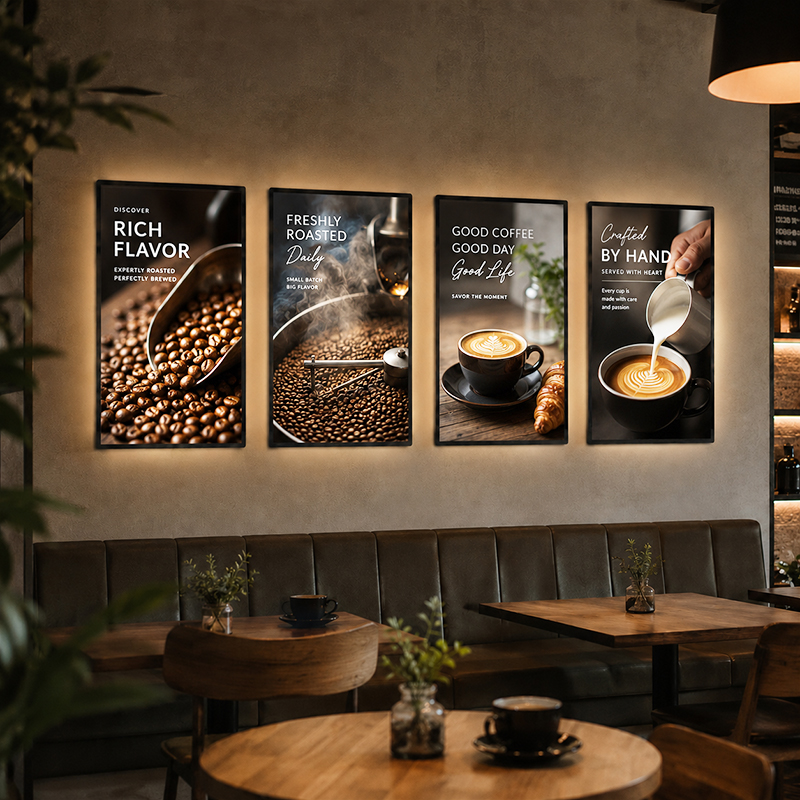
A café measures the wall behind its counter, picks the light box that fills it, and orders a set. The boards go up, and from the till the menu looks sharp. Then the morning queue forms by the door, four metres back, and nobody standing there can read the prices.
Your Attractive Heading
That is the usual sizing mistake. Wall space only sets the upper limit. The size a menu board actually needs comes from how far away people read it. Measure the farthest point customers read from, work out the letter height that distance calls for, and count the lines on your menu. The board size follows from those three numbers.
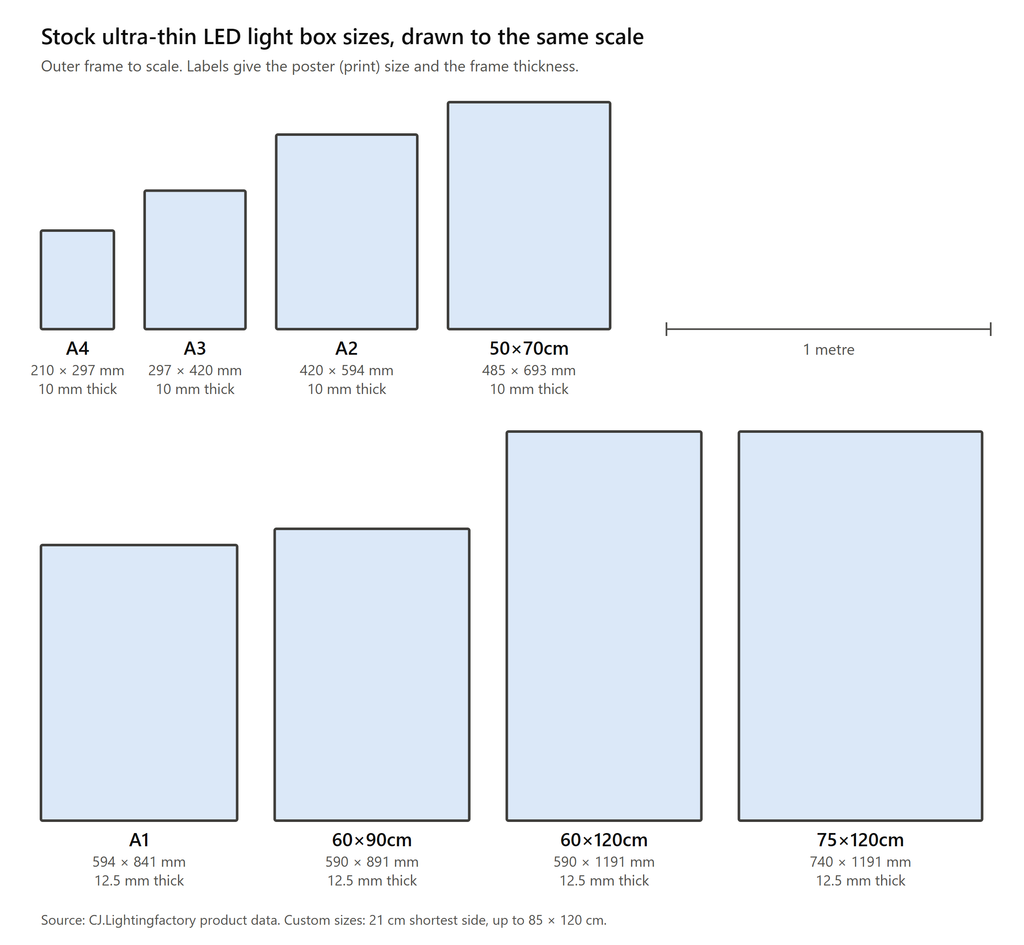
This guide works through the method with the eight stock sizes of the CJ.Lightingfactory ultra-thin LED light box, from A4 to 75×120cm.
The short answer: size by reading distance, not by wall space
For a single-column menu set in a plain sans-serif typeface:
| Reading distance | Capital letter height | About 10 menu lines | About 15 menu lines |
|---|---|---|---|
| 1.5m (5ft) | 12.5mm | A4 | A3 |
| 3m (10ft) | 25mm | A2 | A1 |
| 5m (16ft) | 42mm | 60×90cm | Two boards; no single stock size reaches 15 lines |
When the reading distance doubles, the number of lines a board can hold roughly halves. A board that works fine at the till can fail from the back of the queue for exactly that reason.
The rule behind it: letter height and reading distance
Sign makers size for comfortable reading at 1 inch of capital-letter height per 10 feet of distance. In metric, that is 25mm at 3m, or about 8.3mm per metre. Letter-height charts in the sign trade list it as the distance for “best impact”.
That figure is generous on purpose. Guidance from the United States Sign Council Foundation recommends a legibility index of 30 feet per inch for adequate legibility, multiplied by 0.83 under moderate visual complexity and by 0.67 under high complexity. A menu board with a dozen items and prices counts as a busy sign, which puts the practical limit at about 20 feet per inch. Sizing at 10 feet per inch leaves room for customers who only glance up from the queue, and for glare on the glass.
Menus set entirely in capitals need about 15% more letter height than mixed case, according to the same USSC guidance. And in the US there is no legal minimum to meet: the 2010 ADA Standards exempt menus from their sign requirements (section 216.1, exception 1). Letter height on a menu board is a design decision.
Measure from the farthest point people actually read from
Stand where the queue starts, or where customers first look up as they walk in, and measure horizontally to the wall. Size the board for that distance rather than the distance from the till. In a café where the queue runs back to the door, it can easily be 4 to 5m.
How many menu lines fit on each size
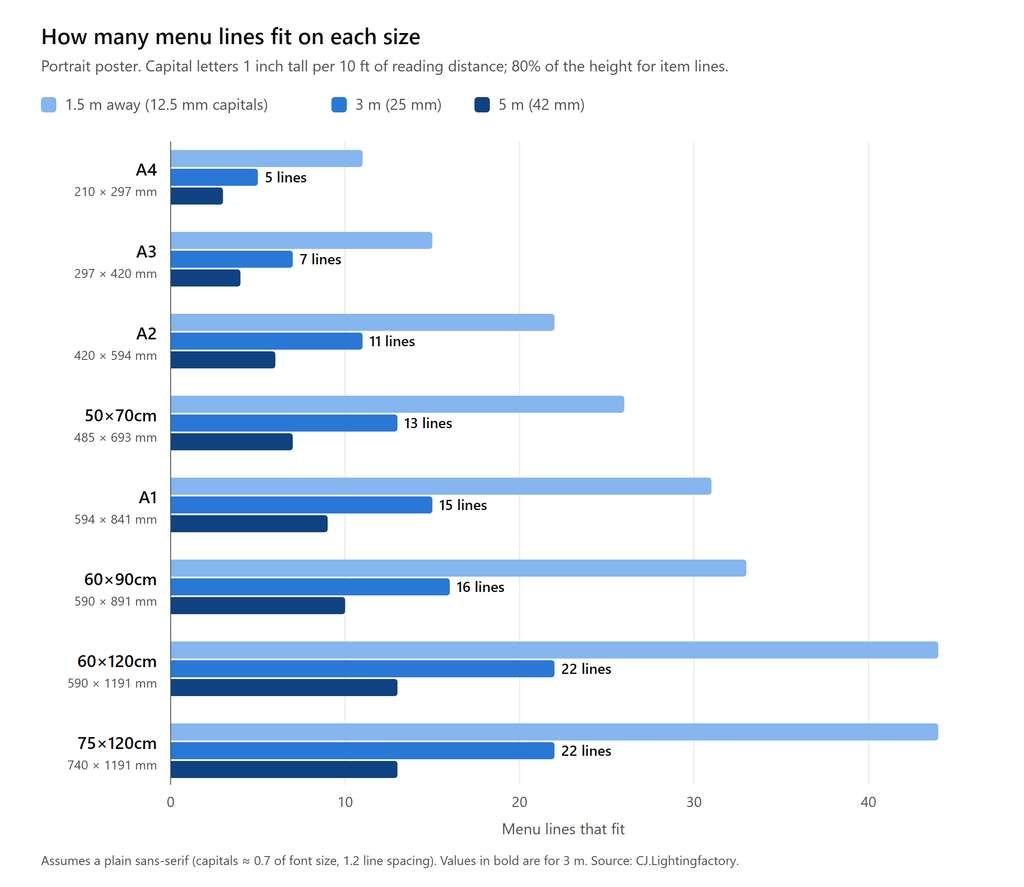
At 3m, a portrait A2 holds about 11 lines of up to 21 characters, and an A1 about 15 lines of up to 30 characters. The table covers all eight stock sizes at three distances.
| Size | Poster size | 1.5m | 3m | 5m |
|---|---|---|---|---|
| A4 | 210 × 297mm (8.3 × 11.7in) | 11 × 21 | 5 × 10 | 3 × 6 |
| A3 | 297 × 420mm (11.7 × 16.5in) | 15 × 30 | 7 × 15 | 4 × 9 |
| A2 | 420 × 594mm (16.5 × 23.4in) | 22 × 43 | 11 × 21 | 6 × 12 |
| 50×70cm | 485 × 693mm (19.1 × 27.3in) | 26 × 49 | 13 × 24 | 7 × 14 |
| A1 | 594 × 841mm (23.4 × 33.1in) | 31 × 61 | 15 × 30 | 9 × 18 |
| 60×90cm | 590 × 891mm (23.2 × 35.1in) | 33 × 60 | 16 × 30 | 10 × 18 |
| 60×120cm | 590 × 1191mm (23.2 × 46.9in) | 44 × 60 | 22 × 30 | 13 × 18 |
| 75×120cm | 740 × 1191mm (29.1 × 46.9in) | 44 × 76 | 22 × 38 | 13 × 22 |
Lines × maximum characters per line, portrait orientation.
For scale, “Flat white 3.40” is 15 characters and “Oat latte, double shot 4.80” is 27. At 3m an A2 (21 characters) fits item names and prices. An A1 (30) has room for a short description as well.
The numbers come from a few assumptions. Capital height follows the 1 inch per 10 feet rule. Line pitch is 1.7 times the capital height, because capitals are about 0.7 of the font size in Arial or Helvetica and lines are spaced at 1.2 times the font size. 80% of the poster height goes to item lines, the rest to margins and a heading. Average character width is 0.7 times the capital height, across 90% of the poster width. A different typeface or layout will move the results by a line or two, so use the table as a starting point.
Why a poster size is not the same as the readable area
The table uses the full poster size. On an ultra-thin LED light box the poster slides in under the frame, which covers a strip along each edge. Keep text and prices clear of the edges, and ask the manufacturer for the visible window size of the exact model before laying out the artwork.
Size by location
Where a board hangs sets its reading distance, so in practice the size follows the position.
Counter and table: A4 and A3
These are read from under 1.5m, which suits a short list: today’s specials, or a QR code for the full menu. A4 and A3 are the only sizes in the CJ.Lightingfactory range that take a desktop stand. If the counter has no socket, an optional 12V 10,800mAh battery pack runs an A4 box for about 12 hours.
Behind the till: A2 and 50×70cm
Read from about 1.5 to 3m. At 3m an A2 holds 11 lines, enough for a coffee list with prices, and the 50×70cm adds two lines and a little width. Both are 10mm thick and can be wall-mounted, floor-standing or suspended.
The main menu for the queue: A1 and 60×90cm
Read from 3 to 5m. An A1 holds 15 lines at 3m and 9 at 5m. The 60×90cm adds about one line at either distance. Both are 12.5mm thick and take wall, floor-stand and suspended mounting.
Long walls and large rooms: 60×120cm and 75×120cm
From 5m and beyond these two sizes still hold about 13 lines. They are wall-mounted only, with no floor stand or suspension kit. For a long counter, a row of A1 boards is the other way to go.
Check the mounting before you commit to a size
| Mounting | Stock sizes |
|---|---|
| Wall (bracket and screws included) | All eight |
| Desktop stand | A4, A3 |
| Floor stand | A4, A3, A2, 50×70cm, A1, 60×90cm |
| Suspended | A3, A2, 50×70cm, A1, 60×90cm |
The boxes are rated IP20, so they are for indoor use. A menu that faces the street goes inside the shop window.
Power needs planning too. Each box ships with its own plug-in adapter, which means three boards in a row need three sockets or a hidden power strip. Sort that out before the wall is finished.
One large board or several small ones?
Once a menu runs past about 15 lines, two or three boards usually work better than one large one. Each board carries its own section, such as coffee, food or specials, and the frames give natural breaks between them. When prices change, you replace one poster instead of the whole menu, and on an ultra-thin light box the poster slides out without taking the box off the wall.
The catch is that boards hanging side by side have to look identical. Two boxes with the same datasheet can still differ in brightness and evenness, and why two light boxes with the same specs can look different goes into the causes. Order the set in one batch, and check two units next to each other before the full order ships.
Before you order: a five-point sizing check
- Measure the farthest reading distance horizontally, from where the queue starts.
- Convert it to letter height: about 8.3mm of capital height per metre (1 inch per 10 feet). Add 15% if the menu is all capitals.
- Count your lines, headings included, and the characters in your longest line.
- Pick the size from the table, then check it against the mounting table and the sockets on site. If no single size fits, split the menu across boards or shorten it.
- Mock it up on paper. Print the menu at full size, tape it to the wall, and read it from the farthest point.
FAQ
For a counter read from 2 to 3m, an A2 or 50×70cm board holds about 11 to 13 lines at 3m, which covers a coffee list with prices. Add an A4 or A3 on the counter for specials.
Only a short one. At 5m, capitals need to be about 42mm tall, which leaves room for about 6 lines on a portrait A2. For a full menu at that distance, use A1 or larger, or split the menu across several boards.
There is little between them: 594 × 841mm against 590 × 891mm of poster, both 12.5mm thick, both available for wall, floor-stand and suspended mounting. The 60×90cm gives about one extra line at 3m. A1 is a preset size at most print services, while 590 × 891mm usually has to be ordered as a custom print size.
Portrait gives more lines and landscape gives more width. At 3m a portrait A1 fits about 15 lines of 30 characters. Turned to landscape it fits about 11 lines of 43 characters, enough for two columns of about 20 characters, or roughly 22 short items. All stock sizes can be hung either way.
No. CJ.Lightingfactory ultra-thin LED light boxes are rated IP20 and are for indoor use. For a menu facing the street, mount the box inside the shop window.
Next step
CJ.Lightingfactory has made ultra-thin LED light boxes since 2013. The range covers eight stock sizes from A4 to 75×120cm, with frames in black, silver or white, and custom sizes from a 21cm shortest side up to 85×120cm. Orders start at 20 sets. The ultra slim light box buying guide has the full size chart and the thickness of each profile. If you send us your menu and the distance it will be read from, we can suggest a size and mounting.
Sources
- Bullough, J. D. (2017). Factors Affecting Sign Visibility, Conspicuity, and Legibility: Review and Annotated Bibliography. Interdisciplinary Journal of Signage and Wayfinding, 1(2). https://doi.org/10.15763/issn.2470-9670.2017.v1.i2.a9 (summarises Bertucci, 2006, and Bertucci & Crawford, 2015, United States Sign Council Foundation)
- Signs Now, letter height and viewing distance chart: https://www.signsnow.com/blog/sign-visibility
- U.S. Access Board, 2010 ADA Standards for Accessible Design, section 216.1: https://www.access-board.gov/ada/chapter/ch02/