
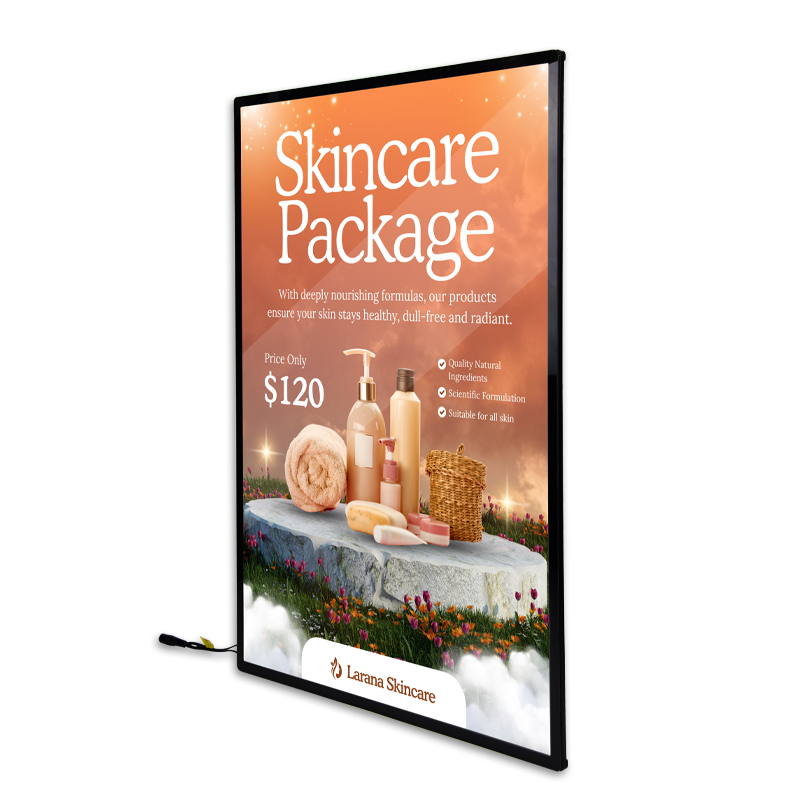
A regional coffee chain sends over its shopfitting drawings before placing an order. Three display positions per store: one above the pickup counter, one facing the street from the window, one freestanding by the entrance. The counter position has a 15mm recess already framed into the millwork. Every quotation on the buyer’s desk uses the same phrase, “ultra slim,” and the depths behind that phrase run from 10mm to well past 30mm. Only some of them will fit.
That gap is where light box sourcing usually goes wrong. Slim is a marketing word, not a specification. The numbers that decide whether a unit fits the opening and lights evenly sit further down the datasheet. This guide walks through those numbers, using the published specifications of the CJ.Lighting Ultra Slim Light Box as the working reference: profile depth, size and graphic dimensions, mounting hardware, power, and optical performance.
What counts as an “ultra slim” light box?
In the CJ.Lighting range, ultra slim means a total body depth of 10mm for the 12V series and 12.5mm for the 24V large-profile series. No industry standard sits behind the term, so treat any supplier’s use of it as a claim to check against a dimensioned drawing rather than a category you can shop by.
The depth figure that counts is body depth, not sightline. Some datasheets quote the visible frame face and leave the rear housing out of it. That is how a “9mm” light box arrives on site needing 24mm of clearance.
The edge-lit structure behind a 10mm profile
A 10mm body is possible because the CJ.Lighting Ultra Slim Light Box is edge-lit rather than direct-lit. The LEDs sit along the inside edge of the aluminum extrusion and fire sideways across a light guide plate, which redirects light forward across the whole panel.
Front to back, the stack is:
- 2mm tempered glass face, 85% light transmission, with a silk-screened border
- Light diffusing material
- Light guide plate
- 225PET reflective material
- 4014 LED strip, edge-mounted
- Aluminum alloy extrusion housing the assembly
Direct-lit boxes put the LEDs behind the graphic facing forward, and they need standoff distance for the individual beams to blend. That distance is what makes them deep. Edge lighting removes it from the equation. CJ.Lighting classifies the output as surface emission, meaning the light guide plate rather than the diode is the emitting surface the viewer sees.
Tempered glass face vs. snap-frame panel
Most ultra slim light boxes sold in Europe and North America are snap frames: four hinged aluminum edges that click open, holding a printed graphic behind a thin PET or acrylic cover sheet. The CJ.Lighting unit works differently. The face is fixed 2mm tempered glass, and the graphic slides in from the edge, in and out in about a second, with no part of the frame opening and nothing to unclip.
Three practical differences follow from that. Changeover on a snap frame means opening and reseating all four edges; the slide-in method is a single motion, which counts when one operator is refreshing eight units before a promotion goes live. Tempered glass also resists scratching from cleaning cloths and passing trolleys, where PET cover sheets haze over time in busy counter positions. Against that, glass is heavier than a PET sheet and the corners need protection in transit, which is why CJ.Lighting ships the units with corner protection angles and sponge padding.
Neither construction is better in the abstract. If a display sits behind a counter and gets handled daily, the glass face earns its cost. For a low-traffic corridor position changed twice a year, a snap frame does the job.
Two profile series, and which one fits your size range
CJ.Lighting builds the Ultra Slim Light Box in two extrusion families. Picking the wrong one is the most common sizing error at quotation stage.
| CTL-Dxxx-12 series | CTL-Dxxx-24 series | |
|---|---|---|
| Body depth | 10mm | 12.5mm |
| Profile cross-section | 11.0 x 8.0mm | 20.0 x 7.9mm and 20.0 x 10.4mm |
| Input voltage | 12VDC | 24VDC |
| Typical size range | A4 through 600 x 1200mm | 850 x 605mm through 750 x 1200mm |
| Glass thickness | 2mm | 2mm or 3mm |
| Mounting | Desktop, wall, floor | Wall, floor |
| Operating temperature | -25 to 45°C | -20 to 55°C |
A1 sits at the crossover and appears in both families. If your order lands at or near A1, confirm with CJ.Lighting which extrusion is being quoted before you sign off on the drawing. The frame face is 11mm wide in one series and 20mm in the other, and on a wall of eight units that difference in visible border is the first thing anyone notices.
Size chart: A-series, millimeters, and inches
CJ.Lighting publishes sizes in ISO A-series and millimeters. Buyers in the US and UK usually work in inches, so both appear below. Product size is the outer frame. Graphic size is the printed area that slides in.
| Product size | Product size (in) | Graphic size | Graphic size (in) |
|---|---|---|---|
| A4, 225 x 304mm | 8.9 x 12.0 | 210 x 297mm | 8.3 x 11.7 |
| A3, 311 x 427mm | 12.2 x 16.8 | 295 x 420mm | 11.6 x 16.5 |
| A2, 435 x 600mm | 17.1 x 23.6 | 420 x 594mm | 16.5 x 23.4 |
| A1, 605 x 850mm | 23.8 x 33.5 | 594 x 841mm | 23.4 x 33.1 |
| 500 x 700mm | 19.7 x 27.6 | 485 x 693mm | 19.1 x 27.3 |
| 600 x 900mm | 23.6 x 35.4 | 589 x 895mm | 23.2 x 35.2 |
| 600 x 1200mm | 23.6 x 47.2 | 589 x 1195mm | 23.2 x 47.0 |
| 750 x 1200mm | 29.5 x 47.2 | 740 x 1191mm | 29.1 x 46.9 |
Why the graphic is always smaller than the frame
The frame overlaps the graphic on all four edges, and CJ.Lighting holds a fixed relationship across the range:
Graphic size = (H – 11mm) x (W – 5mm)
The formula covers custom dimensions too, so a 900 x 1400mm bespoke unit takes an 889 x 1395mm print. Send it to your print supplier with the order rather than letting them scale from the frame size.
One warning for North American buyers. A1 is not 24 x 36 inches. An A1 graphic is 23.4 x 33.1 inches, nearly three inches shorter than a US 24 x 36 poster. Artwork laid out on the US standard will not fill an A1 box, and the shortfall shows up as a dark band along one edge. If your existing print library is imperial, ask CJ.Lighting to quote the custom size rather than substituting the nearest A-series equivalent.
Graphics print onto 180K light-transmission PVC at under 1.5mm thickness. Thicker media will not pass the entry slot.
Four mounting configurations and where each fits
The same panel takes four mounting methods, and every size installs in portrait or landscape.
Desktop mounting uses a stainless steel support rod that clips to the rear and allows angular rotation, so the panel tilts toward a seated or standing viewer. CJ.Lighting specifies this for A4, A3, and A2 units: counter positions, POS displays, table-top menus.
Wall mounting fastens through wall pendants with M3 screws, with the DC input taking a 5.5 x 2.1mm barrel connector at the frame edge. Standard sizes cover A4 through A1 plus 500 x 700, 600 x 900, 600 x 1200, and 750 x 1200mm. This is the configuration behind most menu walls and corridor runs.
Floor standing puts the panel on a weighted base with a telescopic column adjustable between 900mm and 1500mm, with angle adjustment at the panel and suction cup reinforcement at the base. CJ.Lighting specifies it for A2, A1, 500 x 700, and 600 x 900mm. Nothing fixes into the building fabric, which matters in leased retail units and exhibition halls where you cannot drill.
Double-sided illuminated units put two panels back to back for window and walkway positions where traffic passes in both directions.
Frame color is black or silver as standard, and custom colors are available.
Power, optical performance, and certification
Voltage and adapter pairing
Adapter rating follows panel size. Ordering the wrong one underdrives the panel on site, and it is a common enough mistake that it belongs on the pre-shipment check.
| Size | Adapter |
|---|---|
| A4, A3 | 12V, 1A |
| A2, 500 x 700mm | 12V, 1.5A |
| A1, 600 x 900mm | 24V, 1.5A |
| 600 x 1200mm, 750 x 1200mm | 24V, 2A |
Both series run on constant-voltage supplies. Low-voltage DC also means a shopfitter can install the units without an electrician terminating mains at every position.
Light output, color temperature, and lifespan
Published figures for the two reference models:
| CTL-BCA4-12 (A4) | CTL-Dx8560-24 (A1) | |
|---|---|---|
| Power | 7W | 24W |
| LED chip | SM4014 | SMD4014 |
| LED count | 56 | 224 |
| Luminous flux | 630LM ±10% | 2400LM ±10% |
| Color temperature | 7000-9000K, customizable | 7000-9000K, customizable |
| CRI | Ra70 | Ra≥70 |
| Rated life | 30,000 hours | 30,000 hours |
| Ingress protection | IP20 | IP20 |
| Warranty | 2 years | 2 years |
Larger units in the 24V series draw 25W at 600 x 900mm with 240 LEDs, and 32W at both 600 x 1200mm and 750 x 1200mm with 320 LEDs.
Two figures in that table deserve a closer read. The 7000-9000K band is cool daylight white. It makes saturated food and beverage graphics read as bright and clean, which is why these panels turn up in quick-service and beverage retail. It is not a warm-white product as supplied, though CJ.Lighting lists color temperature as customizable. Ra70 is a mid-range color rendering index. That is appropriate for printed graphics, and below what a jewelry or cosmetics display would want if physical merchandise sits next to the panel under the same light.
IP20 means indoor use only. These panels carry no rating for exterior installation, wash-down areas, or unheated loading bays. Operating range is -25 to 45°C for the 12V series and -20 to 55°C for the 24V series.
CE, RoHS, UKCA, REACH, LM-79 and LM-80
Buyers often treat these as one block. They cover different things:
- CE: conformity with the applicable EU directives, required to place the product on the EU market
- UKCA: the equivalent conformity marking for Great Britain
- RoHS: restriction of hazardous substances in the electrical assembly
- REACH: registration and restriction of chemical substances in the materials
- LM-79: the IES test method for measuring luminous flux, color temperature, and CRI of a complete solid-state lighting product
- LM-80: the IES test method for measuring LED lumen maintenance over time, which is what a 30,000-hour rating should trace back to
The last two are the ones to ask about. CE and RoHS establish that a product is legal to sell. LM-79 and LM-80 establish that the brightness and lifespan figures on the datasheet were measured rather than estimated. CJ.Lighting tests to both and runs integrating sphere measurement in its own workshop. Most suppliers in this category publish neither.
Sourcing notes: what to confirm before you order
CJ.Lighting manufactures at source in Guangzhou, with 13 years in ultra slim light box production, a 2,000m² LED workshop, over 200 workshop staff including engineers, and an ISO 9001 management system. Optical testing runs in house.
Before you release a purchase order, pin down:
- Which extrusion series is being quoted, 10mm 12V or 12.5mm 24V, and the frame face width that comes with it
- A dimensioned section drawing, so body depth can be checked against any recess or millwork opening
- Graphic dimensions from the (H-11) x (W-5) formula, issued directly to your print supplier
- Adapter rating per size, and whether the plug type matches the destination market
- Color temperature, if anything other than the standard 7000-9000K band is needed
- Packing configuration for freight planning: A4 units ship 20 per carton at 17kg, outer carton 43 x 37 x 32.5cm, 1.12kg gross per unit
- Which mounting hardware is included, since the support rod, wall pendants, and floor stand are specified separately by configuration
Check packing density early on large orders. At 20 units per carton for A4, a 500-unit opening order comes to 25 cartons and roughly 425kg, which changes whether the shipment moves as air freight or consolidates into LCL.
FAQ
What’s the difference between an edge-lit and a backlit light box? Edge-lit puts the LEDs along the inside edge of the frame, firing across a light guide plate that spreads the light forward. Backlit, or direct-lit, puts the LEDs behind the graphic facing forward. Edge-lit units can be 10 to 13mm deep because no standoff distance is needed for the beams to blend, while direct-lit units need considerably more depth for the same result. The CJ.Lighting Ultra Slim Light Box is edge-lit, at 10mm in the 12V series and 12.5mm in the 24V series.
How many lumens does an A4 LED light box put out? The CJ.Lighting A4 model CTL-BCA4-12 is rated at 630LM ±10% from 56 SM4014 LEDs drawing 7W. The A1 model CTL-Dx8560-24 is rated at 2400LM ±10% from 224 LEDs drawing 24W. Both figures come from LM-79 test conditions, so they describe the complete assembled product rather than the bare LED strip.
What does LM-80 tested mean for an LED light box? LM-80 is the IES method for measuring how much light output an LED package retains over extended operation. A supplier quoting a 30,000-hour rating with no LM-80 data behind it is quoting a number with nothing behind it. CJ.Lighting tests the Ultra Slim Light Box to both LM-79 and LM-80.
Can an ultra slim light box be used in a shop window facing outward? Yes, and CJ.Lighting supplies a double-sided illuminated configuration built for window and walkway positions. The panel itself is IP20, so it has to stay on the interior side of the glazing and is not rated for exposure to weather. For a window position, settle the mounting method with the shopfitter first, since suspended and floor-standing options both work depending on whether the reveal will take a fixing.
What size light box do I need for a standard A1 poster, in inches? An A1 graphic is 594 x 841mm, or 23.4 x 33.1 inches, and the CJ.Lighting A1 frame measures 605 x 850mm (23.8 x 33.5 inches). A1 is not interchangeable with the US 24 x 36 inch poster format: a 24 x 36 print is close in width but nearly three inches taller. If your artwork library is built on US sizes, request a custom frame instead of substituting A1.
Next step
Standard sizes cover most retail and hospitality positions, and custom dimensions, frame colors, and color temperature all come off the same tooling. Send the opening dimensions and mounting positions from your drawings, and CJ.Lighting will return a dimensioned section and a quotation against the correct extrusion series.