1.The Recurring Pain Point at Trade Shows and Pop-Ups: Not Enough Power, Too Many Cables
Anyone who has run a trade show booth knows that power supply is never a minor detail. Venues typically charge extra for each power point, outlets are limited, and booths located further from the venue’s core often need longer cable runs — cables that get stepped on, tangled, or flagged by organizers as a safety hazard. Pop-up retail faces a similar issue: many temporary mall spaces don’t come with a dedicated power outlet, and with tight fit-out timelines, running new wiring often isn’t approved in time. For brands, exhibition contractors, and retailers that rely on light boxes as their main visual display, this is especially frustrating: a light box only does its job when it’s lit, and a poor power position can undercut the visual impact of the entire booth.
2.What Is a Battery-Powered Ultra-Thin Light Box
The ultra-thin light box itself isn’t new: an aluminum frame, a light-guide panel, and edge-lit LED strips work together with a quick-swap PET fabric or PVC poster face, typically achieving a profile of around 1cm. Its original selling point was thinness — compared to traditional acrylic light boxes, an ultra-thin unit takes up almost no depth and weighs very little, hanging on a wall or in a shop window almost as flat as a poster.
The battery-powered version solves a different problem: freedom from fixed power positions. By replacing the plug-in adapter with a rechargeable lithium battery pack, the light box no longer needs to sit near an outlet — it can be placed anywhere on the booth floor, hung from a ceiling with no wiring access, or even taken to an outdoor pop-up, running independently for a full day on a single charge.
3.Key Specifications at a Glance
The specifications below are based on CJ.Lighting’s standard ultra-thin light box range, for reference by buyers and exhibition contractors:
| Item | Spec |
| Thickness | ~1cm for A4/A3/50×70cm; ~1.25cm for A2/A1/60×90cm/60×120cm/75×120cm |
| Power | 7W (A4) up to 33.6W (60×120cm, 75×120cm) |
| Power Input | 12V-1A / 12V-1.5A / 24V-1.5A / 24V-2A, CE-certified adapter included |
| Lithium Battery Option | 12V 10800mAh or 24V 10800mAh, with charger and hangable battery box |
| Runtime on Full Charge | Approx. 8 hours for A1 size |
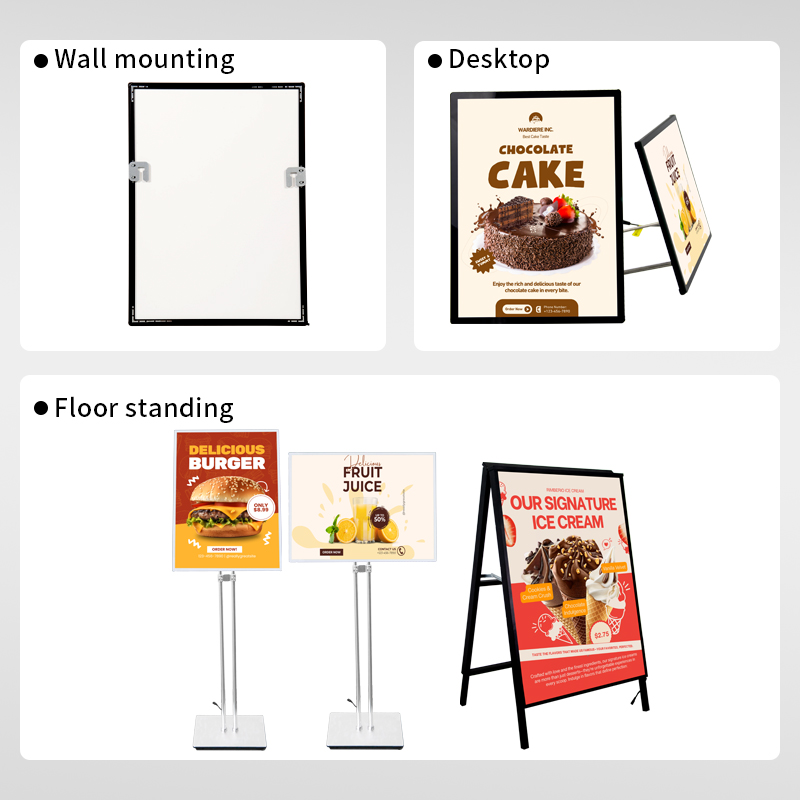
| Installation | Wall-mounted, desktop stand, or floor-standing base |
| Warranty | 3 years |
| MOQ | 20 sets (individually packaged retail version) |
Two things stand out here. First, ultra-thin light boxes simply don’t draw much power — an A4 unit runs on just 7W, which is exactly why a single battery pack can keep it running for a full day. Second, the full size range from A4 to 75×120cm, combined with three mounting options, covers most of the display scenarios seen at trade shows, shop windows, retail counters, and pop-up events.
4.Real-World Applications
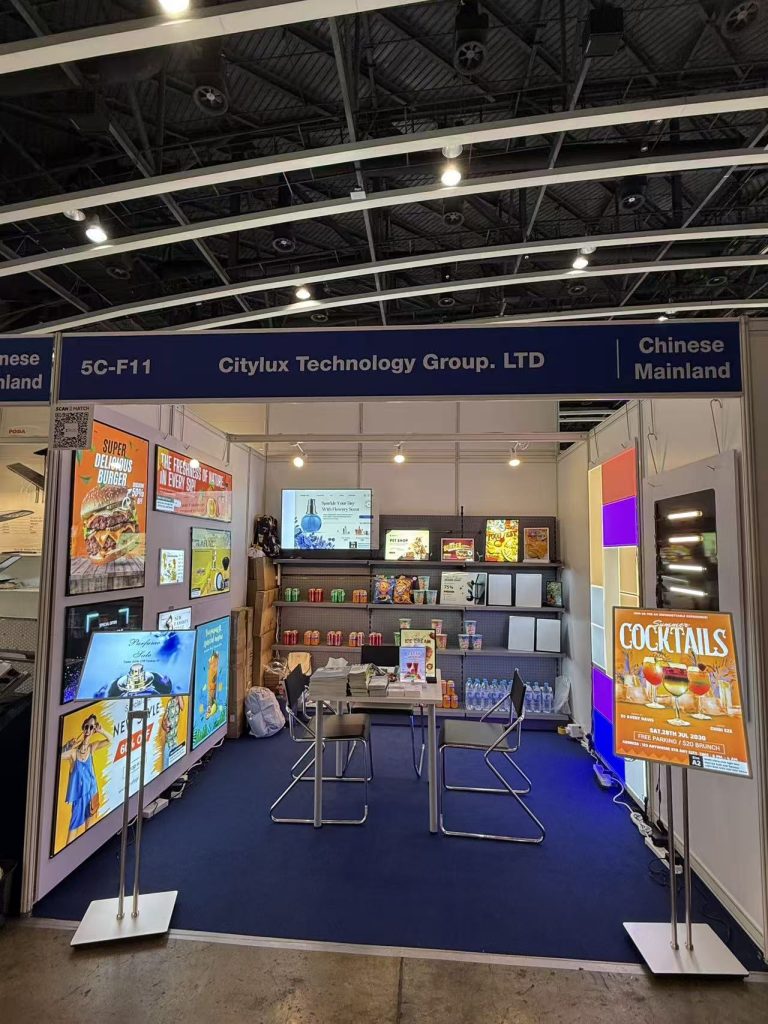
Booth Focal Wall: Booth entrances and meeting areas usually need an eye-catching branded light box, but these zones are often the furthest from the power distribution box. A battery-powered unit can hang directly on the booth’s steel frame, and at teardown there’s no cable to coil up — it simply unclips.
Mall Pop-Ups and Temporary Counters: Fit-out windows are short, and many malls don’t allow wiring changes outside designated points. A battery-powered light box can be hung directly on existing display racks or temporary partition walls with no electrical work involved.
Outdoor Promotions and Roadshows: Night markets, roadshows, and outdoor brand activations typically lack a stable power source. Paired with a floor-standing base, a battery-powered light box can handle lighting and display for an entire event on its own.
5.What to Check Before Choosing an Ultra-Thin Light Box
- Light uniformity: The light-guide panel construction determines whether the image has that dim-edge, bright-center “light box look.” It’s worth requesting a physical sample to compare, not just reading the spec sheet.
- Certification coverage: For light boxes headed to European or North American markets, confirm the power adapter carries CE certification; some buyers also require RoHS or other compliance documentation.
- Custom size and shape capability: Standard sizes cover most needs, but brands often require non-standard dimensions or custom shapes to fit a specific display space — it’s worth confirming sample lead times with the supplier in advance.
- Ease of poster changes: Trade show graphics often need to be swapped for different campaigns. Magnetic or zip-track frames allow a poster change in minutes, with no special tools required.
6.Frequently Asked Questions
Battery-powered ultra-thin light boxes typically come with a 10800mAh battery pack. For an A1-size unit, a full charge provides approximately 8 hours of continuous runtime — enough to cover a full day at a trade show or event.
The standard range covers A4, A3, A2, A1, and common formats such as 50×70cm, 60×90cm, 60×120cm, and 75×120cm. Custom sizes beyond this range can be discussed with the supplier for sampling.
The standard version is designed primarily for indoor use. For outdoor applications, it’s best to inform the supplier in advance about required IP (dust/water resistance) ratings and confirm whether the frame material suits long-term outdoor exposure.
Closing Thoughts
For teams that regularly exhibit, run pop-ups, or handle temporary displays, power positioning is an often-underestimated factor — it doesn’t affect how well a light box displays an image, but it directly determines whether that light box can go where it actually needs to go. A battery-powered ultra-thin light box isn’t really a new product category; it simply removes a longstanding limitation of the standard version, handing the choice of display location back to the user.
CJ.Lighting has long specialized in the custom manufacturing of ultra-thin light boxes — from standard sizes to non-standard custom builds, and from wall-mounted to battery-powered floor-standing versions — offering tailored technical solutions for trade show, retail, and pop-up scenarios.